
IP54 vs IP65 vs IP66: How to Choose the Right Protection Rating for Industrial Enclosures
When designing or sourcing metal housings for sensitive electrical equipment, selecting the correct environmental protection rating is a critical engineering decision. Specifying an enclosure with an inadequate rating will inevitably lead to moisture ingress, dust contamination, short circuits, and catastrophic system failures. Conversely, over-specifying a cabinet for a benign environment results in unnecessarily high manufacturing costs and thermal management complications.
In international engineering, the standard used to define these levels of protection is the IP (Ingress Protection) Code, defined by IEC 60529. For industrial sheet metal fabrication, the three most commonly debated ratings are IP54, IP65, and IP66. While they may sound similar, the engineering requirements to manufacture them and the environments they can survive are vastly different. This comprehensive guide will break down the exact technical distinctions between these ratings and help you choose the right specification for your project.
Before comparing specific ratings, it is essential to understand how the IP code is structured. The rating consists of two digits. The first digit (ranging from 0 to 6) indicates the level of protection against solid objects and dust. A rating of "5" means the enclosure is dust-protected—ingress of dust is not entirely prevented, but it cannot enter in sufficient quantities to interfere with the safe operation of the equipment. A rating of "6" means the enclosure is completely dust-tight, proven by applying a vacuum to the inside of the cabinet during testing.
The second digit (ranging from 0 to 9K) represents the level of protection against water ingress. This is where the physical engineering of the sheet metal—specifically the door flanges, hinges, and gaskets—is truly put to the test. The jump from a "4" to a "6" in this category represents a massive increase in water pressure and volume.
An IP54 rating guarantees protection against hazardous dust accumulation and splashing water from any direction (tested at 10 liters per minute). It is important to note that "splashing" does not include pressurized water jets.
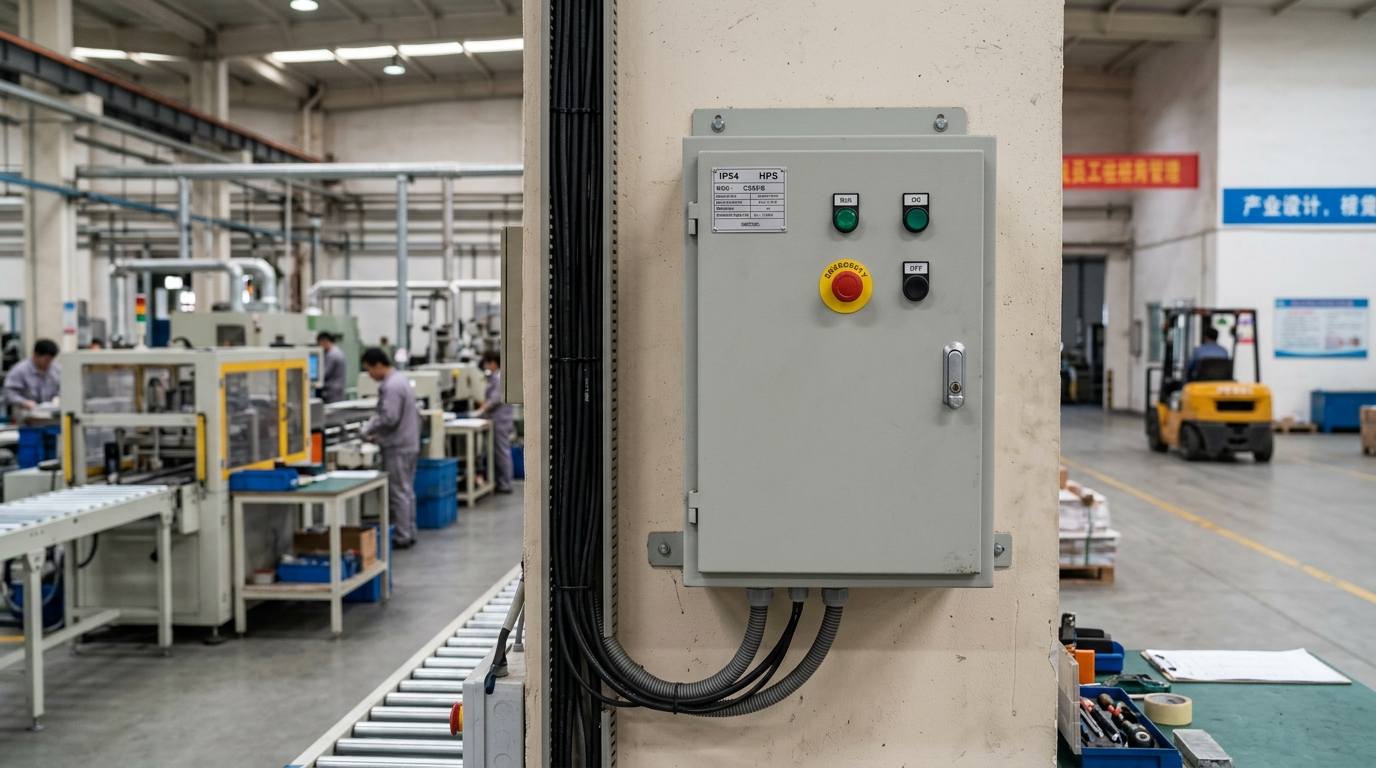
Ideal Applications: IP54 is the industry standard for indoor manufacturing environments. It is perfect for housing PLCs, motor drives, and server racks inside climate-controlled factories or warehouses where airborne dust is present, but heavy water exposure is impossible.
Manufacturing Considerations: Achieving IP54 is relatively cost-effective. Fabricators can often utilize standard spot welding and basic neoprene gaskets. If your equipment will never be deployed outdoors or in a washdown zone, specifying Custom Sheet Metal Enclosures at an IP54 level will save you significant tooling and material costs.
When a project moves outdoors, the engineering requirements change drastically. An IP65 rating signifies that the enclosure is completely dust-tight (the "6") and protected against low-pressure water jets from any direction (the "5"). During the IEC test, this means surviving a 6.3mm water nozzle delivering 12.5 liters of water per minute from a distance of 3 meters.
Ideal Applications: IP65 is the absolute minimum requirement for outdoor electrical infrastructure. It is widely specified for solar inverter housings, telecom base stations, and EV charging kiosks. It can comfortably withstand heavy rainstorms, windblown sand, and general outdoor weathering.
Manufacturing Considerations: To achieve true IP65, spot welding is no longer sufficient. The fabricator must use continuous robotic welding on all external seams to eliminate microscopic gaps. The cabinet doors must feature specialized "rain gutter" folded lips, and the sealing system usually upgrades to a continuous Form-In-Place (FIP) polyurethane gasket to ensure total compression against the door frame.
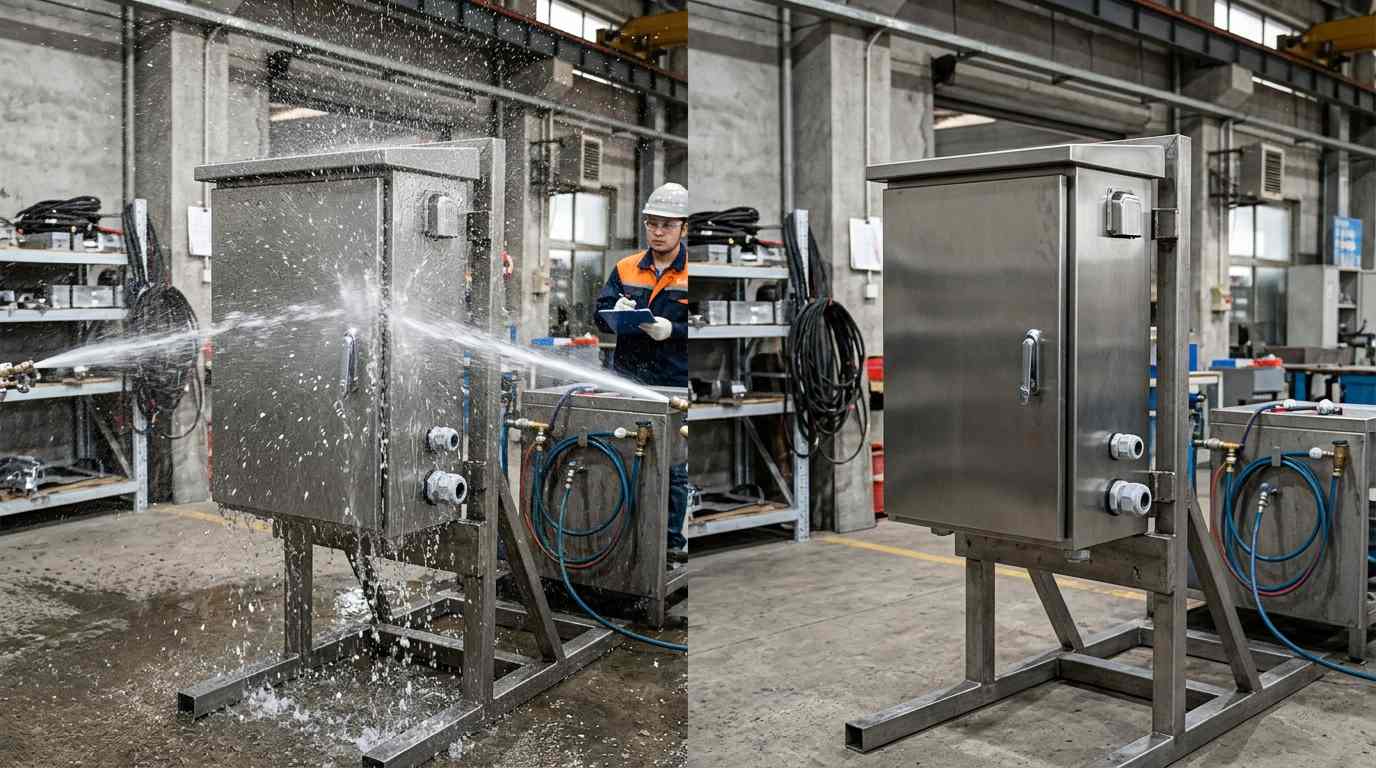
An IP66 rating takes water protection to a severe level. While still dust-tight, it must endure powerful, high-pressure water jets. The test involves a 12.5mm nozzle blasting 100 liters of water per minute at the enclosure. If a single drop of water reaches the internal electronics during this violent test, the enclosure fails.
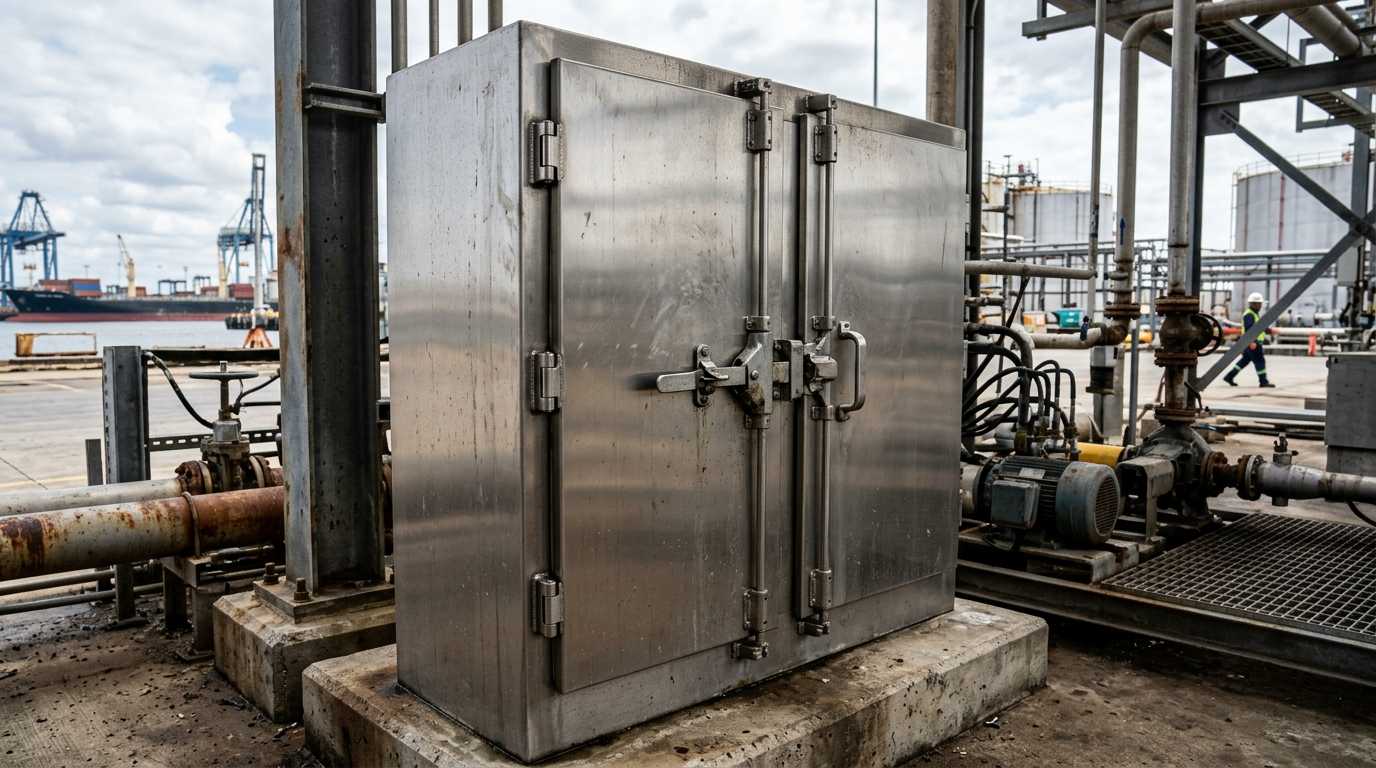
Ideal Applications: IP66 enclosures are designed for brutal environments. They are the standard for marine applications (ship decks), offshore wind farms, and food processing plants where equipment is subjected to daily high-pressure chemical washdowns.
Manufacturing Considerations: Engineering an IP66 cabinet requires heavy-gauge metal to prevent the door from flexing under water pressure. Specialized multi-point latching systems are mandatory to compress the thick gaskets evenly across the entire perimeter of the door. When specifying high-tier Outdoor Electrical Cabinets for these environments, 304 or 316 stainless steel is highly recommended to prevent the heavy water exposure from causing rapid oxidation.
One of the most complex challenges in enclosure design is balancing the IP rating with thermal management. A completely sealed IP66 cabinet will trap internal heat generated by transformers and batteries. If you simply punch ventilation holes and add a standard cooling fan, your expensive IP66 enclosure instantly degrades to an IP20 rating.
To solve this, advanced sheet metal fabricators utilize specialized design techniques. For high-power applications like Energy Storage System Enclosures, fabricators integrate heat exchangers or dual-wall structural designs. A dual-wall enclosure features an inner sealed cabinet (maintaining IP65/IP66) and an outer protective skin. Ambient air is drawn through the gap between the two walls via fans, cooling the inner cabinet without ever exposing the internal electronics to outside moisture or dust.
Choosing the right protection rating is a balance of environmental risk and manufacturing budget. If your project is strictly indoors and away from washdown zones, IP54 is the smart, economical choice. If your equipment will be permanently mounted outside and exposed to rain, IP65 is your mandatory baseline. If your hardware will face extreme maritime conditions or high-pressure water hoses, do not compromise—specify IP66 and utilize stainless steel.
Executing these ratings flawlessly requires a manufacturing partner with advanced CNC forming technology and robotic welding expertise. At Huapusheng, our engineering team works closely with OEMs to design, fabricate, and test enclosures that meet exact environmental standards. Contact us today with your technical drawings, and we will help you engineer the perfect housing for your hardware.
Is an IP65 enclosure fully waterproof?
An IP65 enclosure is highly water-resistant, protecting against rain and low-pressure water jets. However, it is not "waterproof" in the sense of submersion. If you need equipment to survive being temporarily submerged underwater, you must upgrade to an IP67 rating.
What is the difference between IP ratings and NEMA ratings?
IP ratings (IEC standard) only test for ingress of dust and water. NEMA ratings (North American standard) test for dust and water, but they also include additional environmental factors such as corrosion resistance and ice formation. For example, NEMA 4X is roughly equivalent to IP66 but mandates strict corrosion resistance, typically requiring stainless steel.
Why does continuous welding matter for outdoor enclosures?
Traditional spot welding leaves microscopic gaps between the metal sheets. In outdoor environments, water will pool in these gaps, bypass the gaskets, and cause internal short circuits. Continuous robotic welding fuses the seams entirely, which is a mandatory requirement for passing IP65 and IP66 water tests.
 Obtén un presupuesto ahora


 IPv6 RED SOPORTADA
Dejar un mensaje
Escanear a WeChat :

Escanear a WhatsApp :

Hi! Click one of our members below to chat on

 English
 Français
 Deutsch
 Русский
 Italiano
 Español
 Nederland
 日语
 한국어
 Svenska